Rising before the sun, migrant farmworkers in California’s Central Valley often begin their day around 4 a.m. Parents wake children for school, prepare and pack lunches, and make sure everyone is out the door on time. As sunlight begins to spill across the valley — which stretches more than 450 miles from Redding in the north to Bakersfield in the south — one or more household members have already begun work on its 7 million acres of farmland, preparing for a day of hard labor in temperatures that often surpass 100 degrees.
“There are a lot of risks working in the fields,” said Ramón Cruz Medina, who spent some 30 years working on farms, including, most recently, in almond fields near Fresno. “In addition to the heat, heavy fog in the early morning can make the drive to work dangerous. And the pesticides used in the fields can lead to ‘valley fever,’ a fungal infection in the lungs.”
Until changing careers earlier this year, Cruz was among the nearly 800,000 crop workers — also called campesinos — estimated to work throughout California, which produces more than one-third of U.S. vegetables and nearly three-quarters of the country’s fruits and nuts, according to the California Department of Food and Agriculture. Yet despite the state’s $49 billion agricultural industry, the rising cost of living and other factors mean that many farmworkers, especially migrant and seasonal workers, struggle to afford food for their own tables.
For years, siblings George and Linda Arias — whose father was once a campesino — have worked to raise awareness of the needs of migrant farmworkers and their families. Since 2023, they have led the California State Council’s Campesinos program, organizing distributions throughout the state to feed, clothe and assist farm laborers. In that time, they estimate the program has helped tens of thousands of campesinos and their families.
“There’s an absolute need that no one’s doing anything about,” said George, a member of Santa Monica (Calif.) Council 920. “We’re here to serve and say ‘thank you’ to our farmworkers.”
In promoting the program, California State Deputy Ken Rose has met with diocesan and local leaders who sometimes have no idea how acute the needs of campesino families are in their own communities.
“Campesinos are the hidden group nobody wants to talk about, especially while their mouths are full thanks to the farmworkers’ labor,” Rose said. “Anything we can do as Knights to help these families continue to grow and flourish is important.”
PLANTING SEEDS OF SERVICE
George and Linda’s father, David Arias, arrived in California from Mexico in the early 1950s as part of the Bracero Program, the guest worker program agreed to by the United States and Mexico to fill agricultural and manual labor needs from 1942 to 1964. Although David remained in the program only a few years, he spoke with pride about his work in the fields and ensured his children understood the hard work and sacrifice required to bring food from farms to their dinner table.
Even after their parents died, George and Linda remained close to Claretian Father Albert Vazquez, who celebrated their parents’ wedding Mass in 1961 and who, at age 97, has spent more than 60 years ministering to migrants and immigrants in three states. As he grew older, Father Vazquez — also a member of Council 920 — expressed concern about who would continue outreach to this community.
“Don’t worry, Father,” George and Linda told him. “There will be others. We’ll take care of it.”
The siblings’ friendship with Father Vazquez and their relationships with campesino communities throughout the state motivated them to raise awareness about the difficulties facing farmworkers and provide material support where possible.
Official tallies of the total number of migrant farmworkers vary and are often incomplete because they do not include immigrants living in the country without legal permission, who constitute nearly 60% of the farming workforce, according to a 2022 report from the Public Policy Institute of California. That same year, researchers from the University of California, Merced, found that 42% of farmworkers reported low food security and median personal wages of $16,000 per year.
“They’re working 12- to 16-hour days, six days a week,” Linda said. “Children as young as 12 can work in the fields, too. They start working at 4 a.m., and they’re in class by 8 a.m., tired and hungry. The high school graduation rate is atrocious.”
The turning point for their efforts came in 2019, when George was serving as grand knight of Marina Council 4834 in Venice. The council had purchased winter jackets through the Knights of Columbus Coats for Kids program to distribute near Santa Monica, but hardly anyone came to receive them. At Father Vazquez’s urging, Council 4834 brought more than 200 coats to migrant farmworkers in Fresno, some 220 miles north.
The response was overwhelmingly positive, George recalled. After the distribution, some people approached him and said, “We have a real need for food. Can you help us?”
George and Linda soon realized that, despite the Central Valley’s status as an agricultural hub, many families had little access to food banks or similar assistance. Additionally, distributions from existing pantries might take place monthly or periodically, but rarely more than once a week.
“So, we regrouped and brought other councils in,” George said. “That’s how the Campesinos program got started.”
Within six months, he and Linda had partnered with local grocery stores and councils to organize a distribution serving 200 Fresno families. Another event followed near Christmas — a holiday feast held at St. Paul Catholic Newman Center in Fresno, complete with china and crystal glassware, a mariachi band and gifts for everyone, all provided by the Knights and other sponsors at no cost to the families.
A few years later, the Knights returned for a distribution event serving more than 2,000 people in Raisin City. This time, the campesino families insisted on preparing a meal for the volunteers in gratitude for the Christmas dinner held years earlier. One family told Linda, “We’d never seen that before — a plate just for salad, or wine on the table. The way we were treated that night, we have never felt so appreciated in our lives.”
FIELDS OF HOPE
In 2020, Linda and George formed Reserva de la Casa, a nonprofit organization supporting their campesino outreach. In the years that followed, they collaborated with several councils to organize food and supply distributions and provide additional support. But a new chapter began with the 2023-2024 fraternal year, when State Deputy Gregory Marracq decided to make the initiative a formal program of the California State Council.
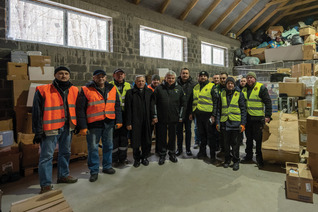
Four distributions took place during the first year — two in Southern California (Mecca and Oxnard) and two in the Central Valley (Cutler and Easton). The Cutler event was particularly timely, as 5,000 campesinos had just lost their jobs after a large fruit company declared bankruptcy.
Members of councils throughout California drove several hours to volunteer at the distributions, and by the time the program’s Raisin City event arrived in November 2024, Knights were prepared to serve thousands.
Ramón Cruz attended the Raisin City distribution with his wife, Patty, and their five children. The generosity they witnessed had a profound impact on them.
“Since my brother died, my sister-in-law has had to work on a tomato farm while raising two children,” Patty said. “Imagine how happy she was to receive the Knights’ support — there was enough food to stock their pantry for three weeks.”
The Cruzes were no strangers to support from their church community; their oldest daughter had been diagnosed with cancer twice by the age of 18, and their son is autistic. Family members, friends and parishioners had always showered them with prayers and assistance. Ramón recognized the same selfless service in the Knights, and he was so moved that he joined the Order on the spot.
“I saw the joy of the people who were able to take something home, some food for their children,” Ramón said. “The support the Knights are providing is exactly what’s lacking in our community.”
This fraternal year, George and Linda Arias have aimed to host 12 Campesinos events — a significant increase from previous years — thanks to a push from State Deputy Rose encouraging K of C chapters in every California diocese to host distributions.
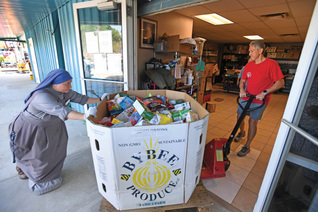
Through a combination of fundraising and material donations, each distribution provides families with clothes, diapers and other essential supplies, in addition to a “Box of Hope,” which includes 20 pounds each of beans, rice, sugar and Maseca flour, along with a gallon of cooking oil. Each Box of Hope costs about $100, and more than 2,000 have been distributed during the past year.
“As Knights, we are called to look for Jesus in everything we do,” Rose said. “If I can touch the life of just one family, it’s all worth it.”
The program has not been without challenges. Some have asked Linda whether the program implicitly supports illegal immigration because many campesinos lack legal status; others question whether the need for such large-scale distributions truly exists.
“We’re not political,” Linda said. “We’re not questioning immigration. We are questioning the humanity of the conditions they live in.”
She continued: “Once you hear something, you can’t ignore it. You need to take action. And the Knights of Columbus, when gathered in brotherhood, are a force of nature.”
*****
ELISHA VALLADARES-CORMIER is senior editor of Columbia and a member of Fremont (Ohio) Council 591.
*****
Read more about how Knights of Columbus councils are helping migrants in their communities here.