“You will see how this touches the lives of every single person we pass by,” said District Deputy Hector Jimenez, a longtime organizer of the Via Crucis and the council’s charter grand knight. “Whether you’re a believer or not, you have to ask: ‘What are those guys doing?’ And if seeing what Christ did for you doesn’t make you cry, I can’t think of anything that will.”
Knights have been responsible for the cathedral’s annual Via Crucis since Council 17254 was established in 2019. All 120 members of last year’s cast and crew were Knights or their family members.
Preparations for each year’s performance begin as soon as the previous year’s event ends. Organizers must file for permits to close streets and request police presence along the half-mile route months in advance. There are expenses to consider, too: In 2023, producing the Via cost more than $6,000, though it would have been much more without support from the New Jersey State Council, benefactors and generous discounts from contractors. Jimenez believes it is money well spent.
“The number of hours or money [we invest] doesn’t matter; the mission of our council, we always say, is the conversion of one soul at a time,” he affirmed.
In fact, the Good Friday procession was one of the primary reasons the council was chartered. The cathedral first held a Via Crucis performed by adults in 2012. For several years, Jimenez and two other men were the sole organizers; the community event was held in the parish gym and never drew more than 900 people. When Msgr. Geno Sylva arrived at the cathedral in 2018 as its new rector, he saw the Via Crucis’ potential for growth and service to the cathedral’s — and Paterson’s — large Hispanic community. The state’s third-largest city, Paterson is home to more than 50 ethnic groups, with Hispanics making up 63% of its 156,000 residents.
“We have to make this bigger,” Jimenez recalled the rector saying.
But to do that, they needed help: “I need more guys,” Msgr. Sylva, a Knight for more than 30 years, told Jimenez. “I need the brothers.”
“Msgr. Sylva is a go-big-or-go-home kind of guy,” said Jimenez. “So, we went big.”
Council 17254 was chartered in 2019, and its impact was immediate. The Knights were among the few volunteers able to assist Msgr. Sylva during the COVID-19 shutdown, and the council soon established a Christmas event that distributes thousands of winter coats and toys annually to families in need. The city’s poverty rate of 24% is among the highest in the state.
“We have our challenges, and we have our difficulties,” said Jimenez. “And I believe that’s where our faith and the Knights of Columbus shine.”
The Via Crucis, which has roughly doubled in attendance every year since 2021, remains the council’s premier effort because, Msgr. Sylva explained, it is central to the Knights’ call to go into the community and bring people to Christ.
“[As Knights], our mission is to reach out to everyone and invite them … so they can come here to receive the highest form of grace the world will ever know: the Eucharist,” the rector said. “We’re always inviting other people to a more active engagement in the life of the Church.”
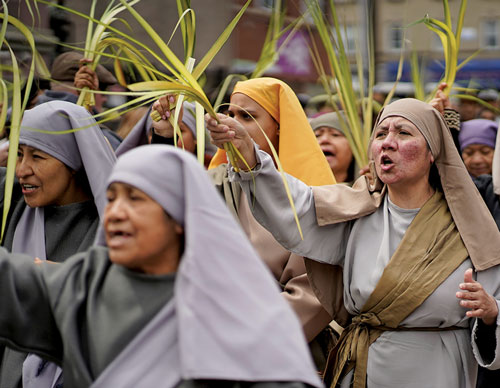
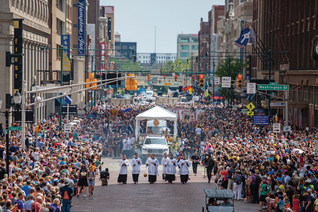
The 2023 Via Crucis began at half past noon on Good Friday. Festive Middle Eastern music and cries of joy rang through the street in front of the cathedral as attendees, joined by Bishop Sweeney and other clergy, waved palm branches welcoming Jesus to Jerusalem. Minutes later, joyful rhythms gave way to ominous sounds as readers — alternating between English and Spanish — began to narrate the events of Christ’s Passion.
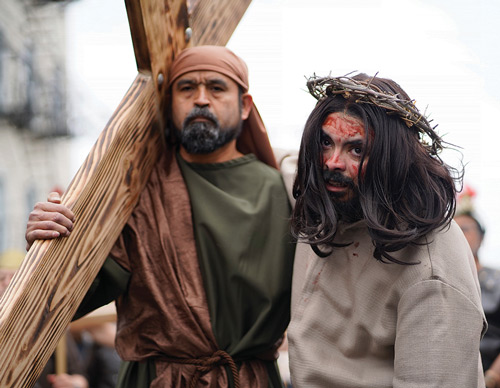
The procession began in earnest once Christ had been sentenced to death by Pontius Pilate. Starting at the cathedral and traveling a loop of several blocks, it stopped periodically so that Bishop Sweeney could lead a reflection on each station.
Though many of the actors in the Via Crucis had never performed before, biweekly rehearsals beginning in January prepared them for their roles.
Of course, no role necessitated as much discernment as that of Jesus. Working with the cathedral’s three priests, Jimenez looked for a dedicated man who desired to make Jesus more present in his life. Out of six or so candidates, Stivenson Pulgarin got the call. And it couldn’t have come at a better time.
“It was something I needed to go through,” Pulgarin recalled, reflecting on his experience. “Playing Jesus was a powerful reminder that he died to give everyone a second chance, even me.”
Pulgarin served four years in the U.S. Marine Corps before returning to New Jersey in 2014. Like many veterans, he struggled to find a sense of belonging in civilian life, leading to what he described as a dark period that reached its lowest point in 2020. Seeing how fulfilled his father was as a member of Council 17254, Pulgarin decided to join the Knights in 2021. The next year, he played Peter in the Via Crucis, but he never expected to play Jesus. He has never acted outside of the Via and considers himself shy and stoic — characteristics that actors are not generally known for. After rehearsals, he would return home physically and mentally exhausted. Still, Jimenez encouraged him, saying, “Don’t worry. The emotions will be there.”
Jimenez was right. As Pulgarin made his way along the half-mile route, being whipped, tripped and beaten, the physical and emotional toll of the role began to mount. The soldiers didn’t pull their punches, and the bruises they inflicted would stay with Pulgarin for at least a few days, he said: “It felt like I was hit by a truck.” Feelings of sadness and anger from the crowd spilled over: “How could they have treated Jesus like this 2,000 years ago?”
Moved with sympathy, onlookers watched the figure of Christ with tears in their eyes.
“People scream at the soldiers, ‘Don’t hit him anymore!’” Jimenez recounted. “When the soldiers get too close, some of the old ladies will try to pinch them, almost as a way to get even.”
The procession returned to the cathedral for the Ninth Station, where Pulgarin fell for the third time. As he lay on the ground, hundreds of people passed him by on their way into the cathedral; an overflow crowd watched on a large screen outside.
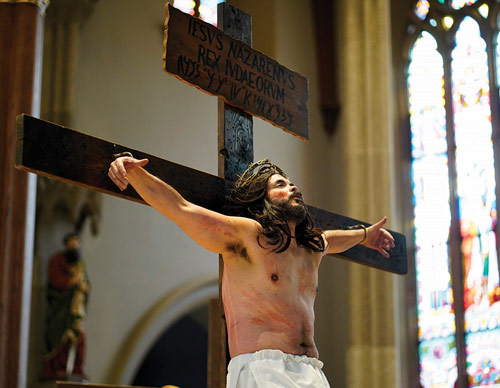
The soldiers dragged Pulgarin toward the sanctuary before fastening him to the cross; the blows of their hammer sent a chilling echo throughout the church. After the cross was raised, Pulgarin looked out at the crowd, lifted his eyes to heaven and recited Jesus’ last words: “Padre mio, en tus manos encomiendo mi espíritu” (“Father, into your hands I commend my spirit.”).
The production came to a close at exactly 3 p.m. with Mary cradling Jesus in her arms to the sound of the song “Diário de María” (Diary of Mary). The entire Via Crucis cast then swiftly and quietly processed out of the cathedral, and the Good Friday liturgy began.
Earlier in the day, before the procession, Msgr. Sylva observed, “We’re witnessing to the truth that Jesus silenced death from the wood of the cross.” He added, “In so many parts of the world — look at Nicaragua — people can’t profess their faith publicly. And if just one or two people looking out of a building [at the Via Crucis] have their hearts opened to the truth, it will have all been worth it.”
The tradition of public processions that Hispanic Catholics have brought to the diocese is a blessing, affirmed Bishop Sweeney.
“Many Latino countries — Peru, the Dominican Republic, Mexico — are part of the faith community here at the cathedral,” the bishop said. “And they are helping the entire city of Paterson to pray together and walk with Jesus on this Good Friday.”
Jimenez hopes to see the Via Crucis draw as many as 10,000 people in the coming years, envisioning a milelong route from the cathedral to a local baseball stadium. Why? Because the Passion story needs to be told — and retold.
“Before the Catholic faith was spread using the written word, everything was word of mouth,” he said. “People told stories by reenacting them so people would not forget them. And that’s why we do this.”
*****
ELISHA VALLADARES-CORMIER is associate editor of Columbia and a member of Sandusky (Ohio) Council 546.
By Caty Mraz
College Knights help build ice chapel for annual event at Michigan Technological University
By Leonard J. DeLorenzo
Drawing on the wisdom of St. John Henry Newman, Pope Leo XIV illuminates the way forward for Catholic schools in the AI era
By James Day
Weekslong pilgrimages conclude in Los Angeles, united in Eucharistic witness and Christian hope
By Kristina Millare
Thousands of U.S. pilgrims, including college Knights, gather in Rome for the Jubilee of Youth
A weekend walking pilgrimage honors the Apostle of California through prayer and public witness
By Columbia staff
The Sisters of Mary in the Philippines educate and care for thousands of girls from impoverished families
By Maria Wiering
The 10th National Eucharistic Congress strengthens Knights and others in missionary discipleship
By Cecilia Engbert
Knights host a pilgrimage for Indigenous Catholics to Québec’s Shrine of St. Kateri Tekakwitha