For the past four years, Blessed Anacleto González Flores Council 4344 in Tepatitlán, Mexico West, has worked with community members to organize a reenactment of the Stations of the Cross during Holy Week at Espacio Grato Para la Tercera Edad A.C., a nursing and retirement home. The event draws more than 120 people each year.
Council member Francisco Sanchez Jauregui showed up to support his brother Knights and join in the time of prayer. But before the Via Crucis procession began, Jauregui was unexpectedly asked to portray Simon of Cyrene when the original actor was running late.
“I didn’t have suitable clothing or appropriate footwear. The cross was uncomfortable, heavy and truly exhausting to carry,” Jauregui said. “I wasn’t prepared to carry that cross, but Jesus asked me to be there and help anyway.”
This role of carrying the cross is one that Knights and other Catholics around the world step into each Lent, especially on Good Friday, to remember, contemplate and more fully accompany Christ in his Passion.
A SOBERING TASK
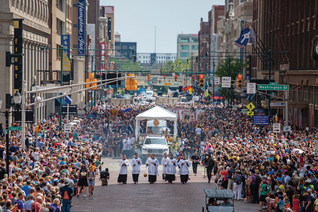
For more than 35 years, the Diocese of Calgary has partnered with local parishes and Knights of Columbus councils to organize an outdoor Way of the Cross procession on Good Friday. What once drew about 200 people now attracts more than 2,000 participants who walk more than 2 miles through downtown Calgary, accompanying the actors portraying the Lord’s Passion. Knights serve as marshals and help carry the cross each year.
Grand Knight Timothy Dahm of Msgr. Doyle Council 1186 in Calgary, Alberta, coordinates the safety team and has been involved since 2019, when he first helped carry the 8-foot cross. “You can feel the fibers digging into your hands, the concrete under your feet, the wind in your face,” he said. “After a while, it gets very heavy and digs into your shoulder, and you realize that this is Christ — this is what he really went through.”
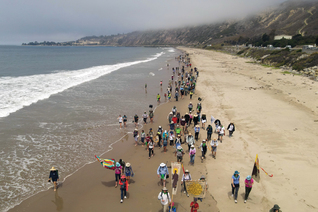
Nearly 1,500 miles south, a similar devotion takes place in a very different landscape. On Good Friday, St. John Vianney Council 17868 helps organize the Stations of the Cross along a mountainside at the Chapel of the Holy Cross in Sedona, Arizona, drawing more than 150 participants annually.
Grand Knight Nicholas Henning, one of the volunteers who has carried the more than 70-pound cross along the steep incline overlooking the desert, has helped with the procession since it began in 2022.
“When you’re carrying the cross, you’re so focused on that, that everything else melts away,” Henning said. “It’s sobering to know he was carrying that cross for us; his heart was beating stronger for us; his love for us is what drove him to complete the Father’s will.”
‘TESTIFYING TO CHRIST’
While the journey to Calvary with Christ is a personal one, it is also meant to be made in communion with others.
St. John Paul II Council 17030 in Sierakowice, Poland, works with St. Martin Parish to organize a family-friendly Stations of the Cross that attracts about 600 participants. The Knights help coordinate traffic, read reflections and carry the cross, while children from the parish’s missionary group present live reenactments.
“This event supports the growth of family life and encourages families to engage in the life of the Church on the path to holiness,” said Father Tadeusz Knut, pastor and council chaplain. “The Knights play a significant role in fostering the stability and faithfulness of families. As St. John Paul II said, ‘The family that prays together, stays together.’”
This prayer often extends beyond the parish to the wider community, especially to those who may not know or practice the faith.
“The desire to participate in this public witness of faith really does fortify my own faith,” Dahm said. “Our secular society so badly needs events like these. A public witness like this reaches beyond the actual event itself.”
Fatima Council 5672 in Carmen, Visayas, displayed a cross outside its K of C hall, which serves as the first station in a procession for parishioners of St. Anthony the Abbot Parish. Beyond the stations, the cross remains as a visible sign of faith for the community.
The Dominican Republic State Council and several local councils organize an annual Via Crucis on Good Friday through the streets of Santo Domingo. Each year, the procession begins at a different parish and ends at the Basilica Cathedral of Santa María la Menor.
“As a Catholic man, walking through the streets of the city testifying to Christ is an honor that I do with great pride,” said Ángel Dipré, state treasurer, district deputy and member of Father Eulalio Arias Council 12614.
Nelson Reyes, a member of Maria Auxiliadora Council 12333, who has portrayed Jesus in the procession in recent years, sees it as an opportunity to evangelize.
“It is an opportunity for me to accompany our Lord in his Passion and death while inviting others to do the same,” Reyes said. “It is a way of evangelizing those who do not know what our Lord went through to redeem us.”
UNITED IN SUFFERING
In parts of the world marked by war and suffering, the Stations of the Cross take on an even deeper meaning.
In Ukraine, Knights from Holy Martyr Josaphat Council 18321 in Konyushky took part in a Way of the Cross procession that began at St. Nicholas Church in Obel’nytsya and ended at the Church of the Dormition of the Blessed Virgin Mary in Konyushky.
Participants — including Knights and the children and wives of Ukrainian soldiers — were invited to take part in carrying the cross. This active participation served as a way to unite their own suffering with Christ’s, while finding hope in his resurrection.
“There is a depth and gravity as you start the stations,” Henning said. “Then you journey through the sorrow and sadness of the stations. But at the end, you know what’s to come. We know the hope that is right around the corner.”
Despite the different ways the Stations of the Cross are prayed around the world, the devotion invites everyone, both publicly and personally, to enter into Christ’s Passion while entrusting their own suffering to him.
Like Jauregui, most people feel unprepared for what Christ is calling them to in their faith journeys.
“Our crosses are heavy and burdensome, yet we are called to embrace the cross with Christ,” Jauregui said. “He calls us when he wants and how he wants, even if we aren’t entirely ready ourselves. When God wills it, he takes care of everything according to his plan. We just have to say yes.”
*****
MEGAN STIBLEY is associate editor of Columbia.