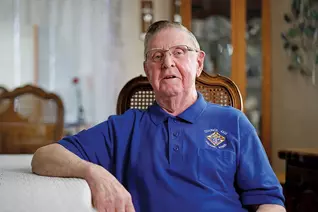
Bronislav Futomskyi clearly remembers the evening in 1996 when he was diagnosed with cancer during a routine checkup.
“The head of the neurology department called me in. She said, ‘I must inform you that you have cancer,’” he said. “You go to sleep with this; you wake up with this — knowing that you have cancer.”
Ten years earlier, in April 1986, Futomskyi was one of tens of thousands deployed to the area affected by one of the most severe nuclear accidents in history — the Chernobyl disaster.
Dozens of “liquidators,” the Soviet government’s euphemism for military and civilian personnel charged with cleanup, security and evacuation, died within weeks of the disaster at the nuclear power plant near Chernobyl (known as Chornobyl in Ukrainian), about 60 miles north of Kyiv. Thousands more are estimated to have succumbed to radiation-related illnesses in the years that followed.
At the time, he had no idea that the radiation would catch up with him a decade later, but the experience ultimately led Futomskyi — past grand knight of St. Charbel Council 16417 in Khmelnytskyi, Ukraine — to a profound spiritual conversion. Today, he organizes emergency medical training for his fellow Knights and volunteers for night shifts in the parish shelter during air raids.
“At all stages of the development of the Knights of Columbus [in Ukraine], he always took an active part,” said Ivan Pravorskyi, Ukraine state membership director, who believes that Futomskyi’s experience at Chernobyl gave him the fortitude he now brings to his council. “He was always in the front ranks, where he remains today.”
AN INVISIBLE KILLER
Futomskyi’s resilient character was tested during the 1980s, when the Soviet regime sought to eradicate the religious identity of Ukrainians. His family held onto their Catholic faith in secret, hiding from the watchful eye of the authorities.
“My mother is deeply religious, and my father is too,” Futomskyi said. “She used to take my sister and me to a village where we went to confession in secret. We hid from the authorities, from the eyes of outsiders, because there could have been trouble.”
In 1986, 29-year-old Futomskyi was serving in an emergency-response regiment in the Soviet Armed Forces.
“On the morning of April 26, I heard in backroom conversations that something had exploded in Chornobyl,” Futomskyi recalled, using the Ukrainian pronunciation of the disaster site. “But we didn’t assume that it was something so massive and terrifying.”
No one could have imagined the scale of the disaster, which occurred when a planned test of reactor cooling capacity triggered a series of explosions that sent radioactive particles as far as Sweden. At the time, it was the most severe nuclear accident in history; only the 2011 Fukushima disaster in Japan rivals it today.
The plant was managed by the Soviet authorities in Moscow, who did not immediately notify the Ukrainian government. The nearby city of Pripyat, where residents experienced headaches, coughing and vomiting as a result of radiation sickness, was not evacuated until the following day.
Futomskyi’s unit was deployed to guard energy reserves around the Chernobyl Nuclear Power Plant and in Pripyat, as the Soviet leadership feared sabotage and looting. The unit also maintained order during the evacuation.
The authorities took steps to hide the magnitude of the tragedy from civilians. “We were forbidden from wearing gas masks so as not to cause panic among the population,” Futomskyi said. “Only later did they start giving us protective fabric masks and respirators, but no gas masks at all.”
Prolonged exposure to radioactive dust particles in the air around Pripyat had fatal consequences for some of the men in Futomskyi’s unit.
“When one of our colleagues passed away later on, the autopsy showed that he had breathed in so many of these particles that his lungs and internal organs were burned through and riddled with holes like gauze,” Futomskyi recalled.
The unit’s contaminated vehicles were abandoned in the disaster zone. The servicemen were evacuated to Kyiv under cover of night and taken to a decontamination facility. The men and their equipment had been so heavily contaminated that, according to Futomskyi, the facility was later demolished.
“During this washdown, they took all of our clothes and gear,” Futomskyi recalled. “They even shaved off my mustache, because when they checked me a second time, it turned out that radiation was still trapped in it.”
‘HE WILL HELP YOU’
As the liquidators left Chernobyl, medics warned them that the effects of the radiation would catch up with them in a decade. The prediction came true with eerie accuracy in 1996, 10 years after the disaster, when Futomskyi was diagnosed with an aggressive tumor on the lining of his bladder.
“I wouldn’t wish the pain I had to endure even upon my enemies,” Futomskyi said. “I am a fairly patient person, but I had to undergo surgeries three times a year.”
The cancer not only drained Futomskyi’s physical strength but also became a severe spiritual trial. The disease refused to retreat, forcing him back to the hospital time and again for a total of 18 surgeries.
“I felt that my soul simply couldn’t take it anymore,” he said. “It was incredibly difficult emotionally; I didn’t have enough time to recover between hospitalizations.”
Futomskyi turned to a psychotherapist with the question, “How am I supposed to go on living?”
“She lowered her eyes and said, ‘You need to go to church. Turn to the Lord; he will help you,’” Futomskyi recalled. “So, I went to the church. I walked in, fell to my knees, and I just broke down. I sobbed so hard; I wept, praying in my own words as best as I knew how.”
In 2014, an ultrasound showed a new growth, and doctors determined that his bladder had to be removed. However, during the operation, the surgeon was stunned: “You have nothing there. The bladder is traumatized from past surgeries, but it’s recovering.”
A checkup three months later found no evidence of cancer. Since 2014, he has been cancer-free, a fact his doctors can offer no explanation for. Futomskyi recently turned 70, convinced that the Lord gave him a second chance in order to serve others.
‘PATRIOTS TO THE CORE’
Futomskyi’s recovery brought with it a renewed desire to live out his faith, leading him to join the Knights of Columbus in 2020. There, his battle-tested character made him a rock of strength for his entire council.
“When the [COVID-19] pandemic hit, Brother Bronislav truly demonstrated his organizational skills,” Pravorskyi said. “And when the full-scale war began, when we organized round-the-clock shifts at our church’s bomb shelter, he pulled shifts for three nights in a row.”
Despite initial anxieties over the country’s fate after the Russian invasion, the brothers’ solidarity restored Futomskyi’s confidence, especially when Knights answered his call to train with veterans in wartime first aid.
“I put out an announcement and didn’t even expect it to interest anyone that much,” Futomskyi said. “Yet a lot of Knights gathered, incredibly many! They are patriots to their core.”
Futomskyi sees brotherhood as a powerful anchor in times of crisis.
“We are holding on. The Knights of Columbus must be the backbone,” Futomskyi said. “We are together, and each of us must be in our proper place, doing whatever we can, and never give up.”
His honesty and love for his country are deeply respected by his fellow Knights.
“Patriotism is something you cannot buy, especially in adulthood: Either it’s there, or it isn’t,” noted District Deputy Viacheslav Maidan. “And this patriotism can be traced back 40 years, when, as a liquidator after the Chornobyl disaster, he served his homeland according to his conscience. He has carried this throughout his entire life.”
To learn more about the Order’s work in Ukraine and to support those efforts, visit kofc.org/ukraine.
*****
KATERYNA KOLODII writes from Lviv, Ukraine.