In 1877, a young Sudanese girl was kidnapped by Arab traders — the same group that had taken her sister just two years earlier. The girl, about 8 years old, was so traumatized by her abduction that she could not remember her birth name. She spent the next decade in slavery.
Frequently beaten and abused by each successive owner, she eventually came to live with a family that did not hurt her physically or mentally. They brought her to Italy, where she was introduced to Christianity. She was soon baptized — taking the name Josephine — and later gained her freedom.
For years afterward, Josephine would return to kiss the same baptismal font, exclaiming, “Here, I became a daughter of God!” She joined the Canossian Daughters of Charity and, for more than 50 years, joyfully served in humble roles at a convent in northern Italy, beloved by her fellow sisters and the local community. She died Feb. 8, 1947, and was canonized in 2000, becoming the first Black woman recognized as a saint in the modern era.
St. Josephine Bakhita is now the patron saint of those impacted by the sin of human trafficking and remains a source of inspiration around the world. Her feast day, Feb. 8, coincides with the Church’s International Day of Prayer and Awareness Against Human Trafficking, which closely follows the United States’ observance of National Human Trafficking Prevention Month in January.
Today, modern slavery — including forced labor, sexual exploitation and forced marriage — affects an estimated 50 million people, according to the United Nations’ International Labor Organization. While the COVID-19 pandemic led to a temporary dip in trafficking worldwide, the number of victims has now surpassed pre-pandemic levels.
Pope Leo XIV, in his first apostolic exhortation, Dilexi Te (I Have Loved You), noted the efforts of the Church — and especially religious orders — to combat these modern forms of slavery. “Christian charity,” he said, “is liberating when it becomes incarnate. … When the Church bends down to break the new chains that bind the poor, she becomes a paschal sign” (61).
In that same spirit, the Knights of Columbus has in recent years committed itself to fighting this crime against humanity. The Order has partnered with religious communities, the Arise Foundation and other organizations to support anti-trafficking programs in places like the Philippines, Nigeria and Ukraine.
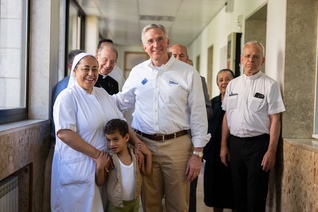
In August 2024, a Supreme Council delegation led by Supreme Knight Patrick Kelly and Supreme Chaplain Archbishop William Lori of Baltimore made a pilgrimage of solidarity to the Philippines. There, they met with local Knights, partner organizations, and several young people who had survived human trafficking.
“Their stories broke our hearts — but nothing could break their spirits,” Supreme Knight Kelly recounted in his 2025 Annual Report. “Their courage strengthened our resolve. These women and children deserve our help. And the Knights of Columbus will be there for them.”
The following pages describe how the Order’s partnerships — and the efforts of Knights on the ground — are helping to heal, protect and transform lives affected by trafficking.
GUARDIANS OF DIGNITY
In 2021, the Knights of Columbus established a partnership with the Arise Foundation to combat human trafficking in the Philippines — a country that has become a global hub for the online sexual exploitation of children, labor trafficking and sex trafficking. In some cases, impoverished parents are even persuaded to sell their children to fake labor agencies or trafficking rings, making it extremely difficult to protect vulnerable families.
“Human trafficking is a scourge that afflicts the country,” said Supreme Director Rene Sarmiento, who served as Luzon North deputy from 2019 to 2023. “Caused principally by poverty, [which is] exploited by criminal elements, this human calamity devalues dignity, toxifies family relationships and weakens the fabric of society.”
Inspired by Father Michael McGivney’s care for widows and orphans, Filipino Knights have embraced the partnership with Arise and see it as an opportunity to practice a charity that evangelizes.
The foundation’s mission is to equip frontline groups with essential information, training and communication tools to build local networks that can prevent trafficking and support the reintegration of survivors. Reflecting the Order’s shared commitment to defend and promote human dignity, Filipino Knights have named the national initiative “Guardians of Dignity.”
“The K of C-Arise partnership is the embodiment of strategic alliance and faith-based charity,” said Chloie Angela Marie Isler, Arise’s coordinator in the Philippines. “This partnership moves us into the realm of systemic resilience-building, rooting the fight against human trafficking firmly within the Catholic moral tradition and establishing a shared platform for national and local advocacy.”
In November 2023, Arise began offering a series of training and capacity-building seminars for K of C leaders across the four Philippine jurisdictions: Luzon North and South, Visayas and Mindanao. For many Knights, these sessions provided a deeper understanding of the scale of the crisis.
“I was a little bit aware but had no real knowledge of cases of human trafficking,” said Mindanao Deputy Rogelio Tedura after a training seminar in March 2024. “I want to implement this at the council level and then collaborate with the community, especially at the barangay (village) level.”
Roseller Bantugan, a district deputy in Davao City who took part in the same workshop, shared a similar response.
“The level of my awareness before the workshop was relatively modest, but it’s now very high,” said Bantugan, who also serves as an elected barangay official. “I learned that there is an interagency task force to combat human trafficking, and I want to make sure it is properly implemented in our barangay.”
More recently, Knights have helped expand awareness by circulating Arise-produced videos and a range of printed materials. For example, in November, Knights in Luzon North visited vulnerable communities throughout the jurisdiction, handing out anti-trafficking resources.
“Thousands of campaign posters, bookmarks and brochures were printed and distributed,” said Supreme Director Sarmiento. “As Guardians of Dignity, Knights have undertaken modest steps to wage this campaign, and we hope to make big strides in the coming months.”
In Luzon South, a dedicated team of Knights is preparing strategic programs to improve identification and reporting of trafficking incidents. In Visayas, meanwhile, Knights are using an innovative “brown-bag” approach to foster informal but meaningful conversations about trafficking. The approach — referring to the practice of bringing lunch in a brown bag — overcomes common barriers to participation.
“Picture this: A small group of Knights gather in a relaxed setting, perhaps during a shared meal such as lunch or a coffee break, creating a space characterized by trust, fraternity and mutual respect,” explained Isler. “This atmosphere sidesteps the formality of traditional training and seminars, allowing for a voluntary exchange of insights and experiences. By encouraging candid discussion, such meetings equip participants not just with knowledge, but with the moral clarity and practical understanding necessary to protect the most vulnerable.”
As the Guardians of Dignity campaign gains momentum, Isler said she is encouraged by the Knights’ dedication and creativity.
“The potential for the Knights to serve as highly effective anti-trafficking ambassadors is profound and uniquely suited to the cultural landscape here in the Philippines,” she said. “Since Knights are trusted fathers, community leaders and businessmen, their message carries a weight of community credibility. Indeed, the Knights of Columbus is perhaps the most underutilized, yet powerful, asset in the national anti-trafficking movement.”
PREVENTING EXPLOITATION IN WARTIME
The risk of trafficking was clear from the outset of Russia’s full-scale invasion of Ukraine, which began in February 2022 and has displaced millions of Ukrainians. According to research conducted by the Arise Foundation, trafficking occurs in 90% of wars and armed conflicts.
When the first wave of Ukrainian refugee families reached the Polish border in early March 2022, the scene was marked by disorder, exhaustion and fear.
“People were driving up in cars and taking women with children — and really, the service providers were not controlling it,” said Marcin Wojciechowski, who serves as program director of the Poland State Council. From the first days of the crisis, Wojciechowski — then grand knight of St. Wojcieh Patron of Poland Council 15267 in Tomaszów Lubelski — led relief efforts in nearby Hrebenne, a village on the Poland-Ukraine border. The council set up tents at the crossing and helped volunteers provide basic services to dissuade women and children from accepting rides from unknown individuals.
The tents offered warmth, privacy, and basic care: hot tea, food, a place to change infants. A volunteer paramedic was also always present.
“At each entrance, we put two male volunteers who let in only women with children,” Wojciechowski said.
With support from the Supreme Council’s Ukraine Solidarity Fund, a larger tent was soon erected and dubbed a Knights of Columbus Mercy Center, giving volunteers a space to assist up to 20,000 refugees a day. Protocols were also put in place requiring drivers to register with the police before taking refugees from the border.
Between March 1 and May 31, volunteers registered more than 290,000 Ukrainians fleeing the war. About 50 Knights from across Poland served in Hrebenne, and another 20 supported operations at the border crossing in Budomierz, 40 kilometers south.
Through its partnership with the Arise Foundation, the Order helped ensure that Ukrainian refugees — especially women and children — had access to assistance beyond the border, reducing their reliance on potentially exploitative networks. The partnership supported groups in Poland, Hungary and Romania that assisted thousands of refugees. Arise reports that 10,534 Ukrainian refugees received direct aid through these regional efforts.
To support the long-term well-being of Ukrainian women and children at risk, the Order also partnered with organizations such as the Pontes Association, a Polish nonprofit dedicated to creating safe spaces for refugees. Since December 2022, Pontes has offered vocational training and mentoring to help prevent economic exploitation.
As Natalia Wróblewska, strategy manager at Pontes, noted, without such help, “neither we nor they will learn anything — only the devastation of war will remain.” Collaborating with trusted groups like Pontes allows the Knights to help refugees find not only safety, but stability and community.
Within Ukraine, the destruction of educational infrastructure has left many children unsupervised — prime targets for abduction and exploitation.
One of the most disturbing aspects of the conflict is the forced transfer of Ukrainian children to Russian-controlled areas. Yale University’s Humanitarian Research Lab estimates that as many as 35,000 Ukrainian children have been taken to Russian-occupied territories. Ukrainian authorities have verified the identities of more than 19,000 abducted children. To date, they report that only 1,898 children have returned.
In response, the Knights of Columbus partnered with Martyrs of the Maccabees Ukrainian Greek Catholic Church in Beryslav, a city on the Dnieper River, to support safe havens such as the House of Happiness in Velyka Oleksandrivka and the Beryslav Hive in Kryvyi Rih.
These centers provide anti-trafficking training for children and parents. Staff conduct regular safety workshops to prepare children for the deceptive tactics used by traffickers and scammers.
“We talk a lot about abuse, about not falling for scams through phones,” explained Father Oleksandr Bilskyi, parochial administrator of Martyrs of the Maccabees Church and chaplain of a local Knights of Columbus roundtable.
The curriculum also covers more immediate dangers such as landmines and prepares children for the “terrible, unpredictable circumstances” of war, Father Bilskyi said. The centers work closely with local authorities, inviting experts to lead training sessions on safety and trafficking prevention.
By funding rent, utilities, and renovations for these spaces, the Knights ensure that Ukrainian children have a refuge where they can learn, heal and remain safely in their homeland.
“Without the Knights,” Father Bilskyi said, “it would be like missing a hand or a leg — an incomplete body cannot function properly.”
JOURNEY TO HEALING
In Nigeria, ongoing violence and the persecution of religious minorities — carried out by Boko Haram and other jihadist groups since 2012 — have fueled a growing crisis. Some humanitarian groups estimate the number of internally displaced persons (IDPs) at more than 3 million, creating circumstances ripe for trafficking.
“Large-scale displacement resulting from violent attacks on communities has significantly heightened vulnerability,” said Chinomso Osuji, Arise’s coordinator in Nigeria. “Trafficking networks exploit the same instability that makes persecution possible.”
Through its partnership with the Order, Arise works with three organizations to combat trafficking in 12 camps for displaced Nigerians throughout the country. In one such collaboration, the Community Links and Human Empowerment Initiative (CLHEI) is training 500 residents in five IDP camps to identify and report trafficking attempts. The organization also works with camp officials to coordinate responses with government agencies and community leaders.
“Their stories broke our hearts — but nothing could break their spirits. Their courage strengthened our resolve. These women and children deserve our help.”
The training has already proven effective, said Helen Teghtegh, CLHEI’s national coordinator. She recalled a recent incident in which traffickers tried to lure children and teenagers from a camp in Benue State with false promises of jobs and education. Thanks to CLHEI’s workshops, residents recognized the danger and reported it, resulting in tighter security and limits on unauthorized visitors.
In an earlier case, however, residents were not as well prepared. A Lagos-based group posing as an aid organization took more than 400 children some 500 miles from the camp under similar pretenses. Parents were able to speak with the children by phone for about a year, but the calls eventually stopped, and efforts to contact the group have since failed. The children’s status remains unknown.
“Investing in these efforts not only reduces exploitation but also promotes safer, more resilient camp environments where individuals are better protected from traffickers,” Teghtegh said.
The Knights’ support also helps CLHEI provide life skills training and small grants to 150 displaced people to help them rebuild their livelihoods. And through another of Arise’s partnerships, some 1,000 women of childbearing age in the camps have received “dignity kits” that include sanitary pads, underwear and toiletries — meeting basic needs while affirming their worth.
According to Osuji, this work offers displaced Nigerians — many of whom were previously self-sufficient farmers — not only protection, but also a renewed sense of agency and hope. As one woman told her, leadership opportunities offer a boost in confidence.
“When you asked us what would work for us and what would protect our children,” the woman said, “that was the first time since we arrived here that I felt like a human being again.”
“For years, [IDPs] have felt spoken for, rather than spoken with,” Osuji reflected. “Being invited to shape the system themselves restores a sense of dignity and ownership — that they are not just beneficiaries, but leaders capable of protecting their community.”
Arise is also working with the Nigerian Conference of Women Religious Against Human Trafficking to support victims and their families. With the Knights’ backing, 20 religious sisters from across the country received training last summer in trauma-informed care and returned to their communities to share what they learned.
“It is easier for survivors to confide in sisters,” said Carmelite Missionaries Sister Theresa Ani, Arise’s liaison in Nigeria. “Their level of trust in the sisters is higher than the level of trust in other lay counselors and therapists.”
In addition to coordinating the training, Sister Theresa also ministers in Edo State, long considered the epicenter of trafficking activity in Nigeria. She recently began counseling a young man there — a trafficking survivor who told her he had never spoken about his experience “because nobody can be trusted, and I am ashamed. But because you are a sister, I feel strongly that I can share with you.”
Sister Theresa noted, “I am journeying with that young man, and I can see him healing by the day.”
That journey of healing, she added, remains long and difficult — but with trusted partners and the continued support of the Knights of Columbus, it is not walked alone.