Devotion to the Sacred Heart of Jesus — rooted in Scripture and developed over centuries in the life of the Church — has long testified to Christians’ trust in the merciful and abiding love of Jesus Christ. In 1675, during the final of a series of visions received by St. Margaret Mary Alacoque, a French nun, the Lord asked that his Sacred Heart be honored with a special feast, helping to spread devotion to the Sacred Heart more widely.
In the three and a half centuries since, Catholics around the world have expressed devotion to the Sacred Heart through acts of consecration, Eucharistic adoration, prayer, and works of charity and reparation. Today, amid renewed interest in the Sacred Heart reflected in Pope Francis’ 2024 encyclical Dilexit Nos (He Loved Us), the Order’s Sacred Heart Pilgrim Icon Program and other initiatives, the U.S. bishops are preparing to consecrate the nation to the Sacred Heart of Jesus on June 11, as the country approaches the 250th anniversary of the Declaration of Independence (July 4).
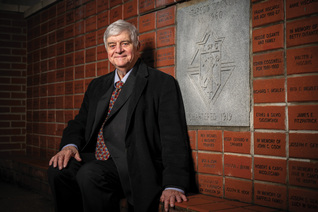
Archbishop Alexander Sample of Portland, Oregon, chairman of the U.S. Conference of Catholic Bishops’ Committee for Religious Liberty, spoke with Columbia about the consecration, devotion to the Sacred Heart, and the role of religious liberty in American society. A longtime Knight and chaplain, Archbishop Sample is a member of St. Mary’s Cathedral of the Immaculate Conception Council 15295 in Portland.
This interview has been edited for length and clarity. To learn more and participate in related initiatives, visit kofc.org/America250.
COLUMBIA: What prompted the U.S. bishops’ decision to consecrate the United States to the Sacred Heart of Jesus this June, and what spiritual fruits do the bishops hope this consecration will bear?
ARCHBISHOP ALEXANDER SAMPLE: The driving force behind this wonderful idea is the semiquincentennial of our country, the 250th anniversary of the signing of the Declaration of Independence. What better way to observe this great anniversary than for our nation to be solemnly consecrated to the true king — Christ the King — and to his Most Sacred Heart.
We bishops see this not just as a symbolic act. We really expect spiritual fruit to come from this consecration — not just for Catholics, but for our whole nation. Our hope is that greater charity will be exercised throughout our country, and that in the heart of Christ we will rediscover the unity that seems to be slipping away from us in today’s divisive culture; that in the heart of Christ we will find ourselves to be friends again, even with those with whom we disagree.
We also hope that justice will be more firmly secured for our nation, that we will continue to strive for equality for all people, and that virtue will flourish — in imitation of Christ, who exemplifies every human virtue.
COLUMBIA: How can Knights of Columbus and other Catholics participate in the national consecration — including at the parish and local council level — and why should families consider consecrating their homes to the Sacred Heart?
ARCHBISHOP SAMPLE: While the national consecration will take place during the June 11 vigil Mass at the U.S. bishops’ annual meeting in Orlando, many bishops will also consecrate their local churches to the Sacred Heart of Jesus around the same time. I’ll be doing that here in the Archdiocese of Portland on Corpus Christi Sunday (June 7) before our grand Eucharistic procession through the streets of Portland.
All parishioners can certainly join with the bishops in this national event, and I hope every pastor will encourage parishioners to actively engage with this consecration — not just the shepherds, but the whole people of God. In so doing, we are also consecrating ourselves to the Sacred Heart of Jesus as citizens of this country and as Catholic members of our own local faith communities.
We also encourage participation at the level of the home, where we are the “domestic church.” It used to be a great tradition in Catholic families to consecrate their homes to the Sacred Heart of Jesus with a blessing and the enthronement of a Sacred Heart image in a place of honor.
I would love to see Knights of Columbus, as husbands and fathers, step up during this time and consecrate their homes to the Sacred Heart of Jesus, and encourage their council members to do the same for their families.
COLUMBIA: In his encyclical Dilexit Nos, published in 2024, Pope Francis wrote that contemplation of the Sacred Heart of Jesus inspires deeper “attentiveness to the suffering and needs of others” — a theme Pope Leo XIV also emphasized last fall in his apostolic exhortation Dilexi Te (I Have Loved You). How should Catholics live out the consecration, particularly in terms of charity and service?
ARCHBISHOP SAMPLE: Pope Leo’s Dilexi Te — the second part of what Pope Francis already laid out in Dilexit Nos about the Sacred Heart — is a reminder that the Church has always had a preferential care and love for the poor. Devotion to the Sacred Heart needs to be seen in this light. Just as we are the presence of Jesus in the world as the Mystical Body of Christ, we also must reflect the love of the heart of Christ for others, especially for the poor and the suffering.
We certainly want that personal devotion for ourselves, our families and our loved ones, but it doesn’t stop there. It must then move us to be the heart of Christ for others. Jesus clearly identifies himself with the poor throughout the Gospels, especially in the parable of the final judgment in Matthew 25.
That must be how the Church lives this consecration. It isn’t just for us in the comfortable community of the Church; it is meant for the world, for the Church to be the heart of Christ for others.
When we care for and minister to the poor and suffering, we see the face of Jesus. But they must also see the face of Christ in us and thus experience the heart of Christ for them. There’s a profound connection between consecration to the Sacred Heart, devotion to the Sacred Heart, and the Church’s care for the poor and suffering in our world.
COLUMBIA: As the United States marks the 250th anniversary of the Declaration of Independence, how do you see the Church’s call to entrust the country to the Sacred Heart intersecting with the nation’s founding?
ARCHBISHOP SAMPLE: Even though we live in a very secularized culture today, we should never forget that this nation was founded on a firm understanding that the rights and dignity of every human being do not come from government, but from God. This nation enshrined that equal dignity and the rights we all enjoy — as people created in the image and likeness of God — in a constitution and a form of government meant to protect and advance those rights and that dignity.
In more recent times, there has been a forgetting of these foundations, and even an effort to set aside the original understanding of our Founding Fathers. This consecration to the Sacred Heart of Jesus is an opportunity for us to return to basic principles — not only of faith, but also of the founding of this nation.
As we make this consecration, the U.S. bishops also hope to highlight the contributions Catholics and the Catholic Church have made throughout the history of this country, especially through educational institutions, healthcare ministries and social service agencies known for their care of the poor and suffering. Without being prideful about it, we should not be afraid to celebrate the role the Church has played in the foundation, growth and advancement of this great land.
COLUMBIA: Religious liberty has long been a defining feature of American life. What particular challenges to religious liberty are of greatest concern today, and how are Catholics to respond?
ARCHBISHOP SAMPLE: A very important distinction needs to be made here. For many people, religious liberty means freedom of worship — everybody is free to worship God as they choose, but only within the walls of a church or synagogue or other place of worship. Yet religious liberty means much more than that. It is the freedom to live our faith and moral principles within the wider culture.
It’s not a question of imposing dogmatic faith on others, but of publicly expressing moral values grounded in the very nature of the human person and in natural law that all citizens share in. That’s what is under threat today in our culture.
To my brother Knights in this great Order: Men, step up at this time. Take leadership in your homes and families. Be, by your baptism, the “priest” in your home, and truly dedicate your family to the heart of Christ.
I like to distinguish two broad areas of concern. On the one hand, there are attempts to force religious institutions to do things contrary to our faith and morals. During the debate over the Affordable Care Act, for example, Church institutions were going to be forced to engage in the provision of artificial contraception. Other examples include proposals in some states that would require priests to violate the sacred seal of confession in order to use information given there for the charging of crimes.
Another broad category of concern involves denying religious institutions access to grants or programs available to others because of our religious identity. One example would be denying adoption services if the Catholic Church will not place children with same-sex couples. A more recent threat is the imposition of gender ideology in our culture today. Pope Francis famously called it “ideological colonization,” contrary to natural law and to the Christian understanding of the human person.
COLUMBIA: Blessed Michael McGivney founded the Knights of Columbus, in part, to combat anti-Catholic prejudice. Do you think anti-Catholicism remains a significant issue today, and if so, how does it manifest itself in contemporary culture?
ARCHBISHOP SAMPLE: I don’t want the Catholic community in the United States to sound like we’re the only victims of religious intolerance or hatred or violence, because other groups — particularly the Jewish community — often suffer far worse than we do. But anti-Catholicism certainly still exists.
I think every diocese in the country has experienced churches being vandalized, especially when contentious political issues spark a rise in hostility. The internet and social media are great ways to connect people and share information, but in some ways they have also become a cesspool of hatred and intolerance.
More recently, the Church has been very concerned that those in immigration detention centers are able to receive the sacraments and pastoral care, and that priests and others serving them are not denied access because of immigration status. There have been isolated examples where the Church’s ability to provide pastoral care for detainees has been denied, and we need to continue making sure we are able to care for these people.
We simply continue to witness to the Gospel. The response of Christ to his persecutors was love. He told us to love our enemies and pray for those who persecute us. There’s our cue. That is how we best respond as Catholics in this country: with love.
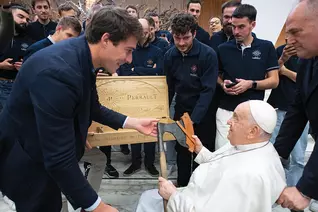
COLUMBIA: This past February, Pope Leo XIV received you in a private audience. What stood out to you from that encounter, and what hopes do you have for his pontificate, particularly with respect to the Church in the United States?
ARCHBISHOP SAMPLE: One thing that stood out immediately was what a great listener he is.
You’re overwhelmed and a little intimidated sitting across from the pope, right? But after a while, it was like I was talking to a guy from Chicago. There was an ability to be more familiar, to use turns of phrase and colloquialisms that would perhaps be lost on a non-native American.
In our conversation, Pope Leo amplified something he said at the beginning of his pontificate: “My job as pope is not to solve the world’s problems. My job is to proclaim Jesus Christ.” I see him doing that in this work of proclaiming the Gospel to a world that needs to hear this message anew, with care for the poor as part of that work of evangelization.
He knows what the mission of the Church is. That’s very clear to me. He has a great sense of meaning and purpose for the Church.
Of course, we all look forward to Pope Leo’s first papal visit home to the United States. I think it is going to be a game changer for the Church here and spark an even greater religious revival in this country. We’re going to see quite a response in terms of people saying, “OK, enough of living without God. It’s horribly lonely. I need to find the real meaning and purpose of my life.” If he is able to proclaim that message effectively, I think it will make a tremendous impact.
COLUMBIA: Many dioceses, including your own, are seeing a rise in converts to the faith. How might devotion to the Sacred Heart of Jesus serve as a path for evangelization and conversion?
ARCHBISHOP SAMPLE: Everything flows from the heart of Christ. We should never forget that. All grace flows from the heart of Christ upon the cross, and after his death, when his side was opened and blood and water poured out, the Church was born from his open side. That’s the great mystery of the Church.
The Fathers of the Church tell us that the water that flowed from Christ’s side reminds us of the waters of baptism, in which we are regenerated and become a new creation and members of the Body of Christ. And the blood is symbolic of the Eucharist, by which we are nourished daily by the very presence of Christ — the body, blood, soul and divinity of Jesus.
The Church’s life flows from the Eucharist, but it also flowed from the heart of Christ on the cross. So if there is to be spiritual renewal in our time, according to God’s plan, it will flow from the heart of Christ.
By consecrating the nation to the Sacred Heart of Jesus, we are disposing ourselves — our country and its citizens — to the outpouring of grace that Jesus wants to give us, flowing from his Sacred Heart, which is the heart of mercy and love for the world.
COLUMBIA: Finally, what would you say to Knights of Columbus members and their families as they prepare for this consecration?
ARCHBISHOP SAMPLE: To my brother Knights in this great Order: Men, step up at this time. Take leadership in your homes and families. Be, by your baptism, the “priest” in your home, and truly dedicate your family to the heart of Christ.
I’m sure you already have a deep faith life in your family, but it can always be improved. Use this consecration to renew devotion to Christ in your homes and families, in partnership with your wife and for the benefit of your children.
Let this consecration of our nation to the Sacred Heart of Jesus be truly a profound spiritual renewal in your own life, in the life of your family, in the life of your councils and in the life of your parishes. Now is the time.