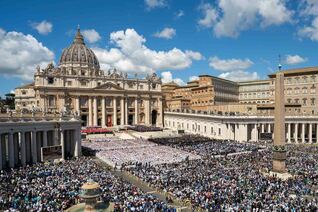
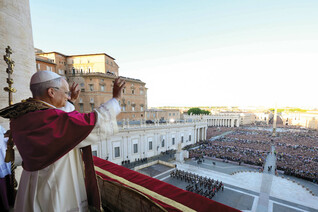
The closing Mass of the Synod on Synodality was celebrated Oct. 27 in St. Peter’s Basilica under the newly restored Bernini baldacchino, now free of scaffolding and gleaming brightly after a monthslong cleaning and preservation project supported by the Knights of Columbus.
The nearly 10-story canopy over the papal altar, constructed in the 17th century directly over the tomb of St. Peter the Apostle, was last refurbished more than 250 years ago.
Beginning in late February, a team of master restorers worked methodically to remove centuries of dust and grime from the massive bronze, marble and wood structure and its many gilded details. They finished ahead of schedule, allowing the baldacchino to be unveiled at the close of the synod instead of, as originally projected, in conjunction with the upcoming Jubilee Year of Hope.
Pope Francis drew attention to the restored baldacchino — or baldachin, in English — in his homily at the closing Mass. “As we admire the majestic Bernini baldacchino, more sublime than ever,” the pope said, “we can rediscover that it frames the true focal point of the entire basilica, namely the glory of the Holy Spirit. This is the synodal Church: a community whose primacy lies in the gift of the Spirit, who makes us all brothers and sisters in Christ and raises us up to him.”
At the conclusion of Mass, the Chair of St. Peter was placed in front of the papal altar for Pope Francis, the bishops and the faithful to venerate. The ancient wooden throne, now believed to date to the 9th century, was held for centuries to be the cathedra of the first pope. It will remain on display until Dec. 8, the solemnity of the Immaculate Conception.
In his homily, the pope urged the bishops to contemplate the Chair with the “wonder of faith” and to “remember that this is the Chair of love, unity and mercy, according to Jesus’ command to the Apostle Peter not to lord it over others, but to serve them in charity.”
Normally housed in a gilded bronze sculpture at the basilica’s apse, the relic was displayed for the first time since 1867 while the massive bronze monument, also by Bernini, is restored with support from the Knights. The Chair of St. Peter monument restoration is targeted for completion by Christmas Eve, when Pope Francis will open the Holy Door at St. Peter’s Basilica to begin the 2025 Jubilee Year of Hope.
Supreme Knight Patrick Kelly, Supreme Chaplain Archbishop William Lori and the other Supreme Officers had the opportunity to venerate the Chair of St. Peter privately Oct. 24. They also climbed the scaffolding that encases the Chair of St. Peter monument to see the restoration work in progress. Donning hard hats and safety harnesses, they also viewed the baldacchino’s upper reaches from mechanical lifts high above the basilica floor.
“It was an extraordinary experience to be on top of the baldacchino, and to be with the artisans and see the great care they bring to their task of restoring this magnificent work of art,” the supreme knight said. “The baldacchino brings together two realities: The reality that God comes to dwell with us, to be with us, and the reality that we are called to raise our hearts and our minds to him in prayer and in gratitude.”
EVANGELIZATION THROUGH BEAUTY
The restorations of Bernini’s baldacchino and Chair of St. Peter monument are just the latest in a series of more than 20 Vatican projects sponsored by the Knights of Columbus since 1980. These include the cleaning of St. Peter’s façade in 1985; the restoration of the Maderno Atrium and Holy Door in anticipation of the Jubilee Year 2000; extensive restoration and construction in the Vatican Grottoes; and restoration of revered frescoes and other sacred art dating to the 14th and 15th centuries. All the projects were led by the Fabbrica di San Pietro, the institution responsible for maintaining the historical and artistic patrimony of the Vatican.
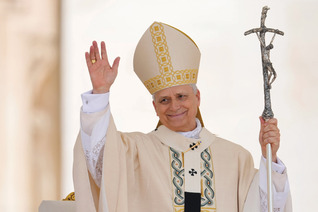
“The Knights have been partners for many years now in the conservation and enhancement of the basilica,” said Cardinal Mauro Gambetti, archpriest of St. Peter’s Basilica and president of the Fabbrica di San Pietro. “Their mission clearly fits in with our objectives, which ultimately is to offer to those who come here — not only Christians but also non-Christians — the opportunity to come into contact with the spiritual dimension of existence.”
In this context, the Order’s efforts to preserve the art and architecture of the Vatican are part of the Church’s long tradition of evangelization through the beauty of sacred art and architecture.
“We make the beauty of this work visible as much as possible,” the cardinal said of the baldacchino restoration, “in its colors, also in its materials, restored to their original state.”
The innovative sculptor and architect Gian Lorenzo Bernini (1598-1680), considered the father of Baroque sculpture, was only 24 years old when he was commissioned to create an ornate baldacchino over St. Peter’s tomb by Pope Urban VIII. A “baldacchino” — from the ancient Italian word for Baghdad, which was known for its luxurious fabrics — was a cloth canopy over a throne. In Rome, such canopies came to be placed over altars in honor of Christ, the King of Kings. Bernini’s baldacchino, constructed from 1623 to 1634, was his first commissioned work in St. Peter’s Basilica.
A ‘WONDERFUL SHOCK’
The restoration work on the baldacchino was completed by several teams of specialists in Bernini’s various building materials — bronze, wood, stucco, masonry and different types of gilding. They spent months cleaning every surface of the baldacchino, its intricate ornamentation keeping them busy from morning to night. The baldacchino’s four twisting columns are adorned with cherubs, dolphins, lizards, plants and insects.
“All these meticulously painted bees!” laughed master restorer Susanna Sarmanti, referring to the more than 100 gilded bees scattered over the sculpture, an allusion to Pope Urban’s family coat of arms. “And what fun discoveries we made — on the top of our column we found a bronze cricket!”
Master restorer Sante Guido marveled the beauty of the baldacchino’s gilded bronze. “The final approach will be fantastic because the gold is shining again,” he said.
Barbara Jatta, director of the Vatican Museums, predicted that the results of the restoration would be “an incredible and beautiful and wonderful shock for everybody.”
Now the same experts are working on the Chair of St. Peter monument, which Bernini built from 1657 to 1666 at the request of Pope Alexander VII.
Pietro Zander, head of the Necropolis and Artistic Heritage Section of the Fabbrica and a longtime collaborator with the Order on restoration projects, considers the back-to-back refurbishment of the baldacchino and the Chair of St. Peter monument as providential in the context of the Jubilee Year 2025.
“We were all aware that once the golden luster of the baldacchino was restored, then the Chair of St. Peter must necessarily follow,” Zander explained. “Otherwise, the Chair would remain in a pitifully neglected condition. For example, the four statues of the Greek and Latin doctors of the Church currently appear very obscure — but all of them are actually golden underneath! So it is symbolically important, therefore, in view of the upcoming Jubilee, to present these two monuments, which were conceived to dialogue together, in their rediscovered beauty and integrity.”
Cardinal Gambetti expressed his hope that the newly restored Bernini masterpieces will leave a lasting impression on visitors of every kind. “May they be attracted by the beauty and splendor of this work,” he said, “and thus allow themselves, in the end, to let go, to allow that desire for the absolute, for the infinite, to be awakened in their heart.”