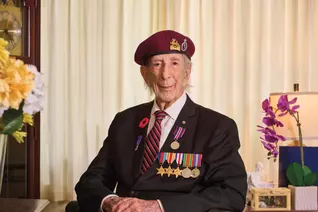
Patrick H. Brady seemed an unlikely candidate for a decorated military career. “I hated the idea of the military,” he recalled of the mandatory ROTC program at Seattle University. “I couldn’t believe they would make me wear a uniform and march ... and say ‘sir’ to these jerks.”
Less than 15 years later, Brady was on his second tour in Vietnam as an Army UH-1H Huey “Dustoff” helicopter ambulance pilot. Through dense fog and enemy fire near Chu Lai, he evacuated 51 seriously wounded men in a single day — Jan. 6, 1968, the feast of the Epiphany.
For those rescues, President Richard Nixon presented him with the Medal of Honor on Oct. 9, 1969. Across his two tours in Vietnam, Brady flew more than 2,500 combat missions and evacuated more than 5,000 wounded people. He retired from the Army in 1993 as a major general.
Brady and his late wife, Nancy Lee Parsek, were married for more than 60 years and had six children. Their daughter Meghan served in the Army Medical Service Corps and co-authored his book, Dead Men Flying, first published in 2010.
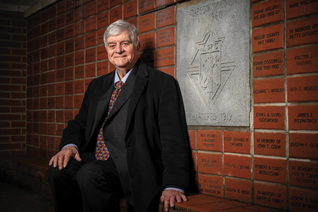
A Knight since 1998, Brady is a member of Our Lady of Perpetual Help Council 6856 in Selma, Texas, and Msgr. Bruno Hubertus Assembly 1791 in nearby New Braunfels. On Sept. 19, he delivered the keynote address at his council’s 50th anniversary celebration.
“The key to happiness in life is sacrifice; I define it as love in action,” said Brady, who turned 90 on Oct. 1. “It’s the sacrifice of veterans, of parents, of first responders, of coaches, of people in our society who take care of us. There’s nothing in it for them. All it will do is increase our capacity for more sacrifice and for leadership — indeed for happiness itself.”
The following is excerpted and adapted from a Knights of Columbus interview with Brady recorded in 2020.
I went to an all-boys Catholic high school in Seattle with the Christian Brothers of Ireland, and my future wife went to an all-girls Catholic high school. The only time our schools got together was on Friday nights, when the Knights of Columbus held a dance. At one of those dances, I met Nancy Lee.
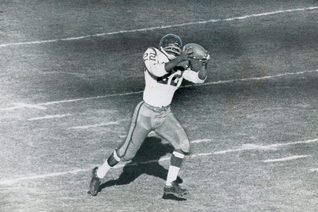
At school, sports were our life. I came out of high school with several scholarships to play football out West, with tuition taken care of. But Nancy Lee was going to Seattle University, a Jesuit university with mandatory ROTC and no football team. I had to figure out whether I wanted to follow her or give up my scholarship. She won, and I went to Seattle University.
But I thought, “ROTC is not for me.” They kicked me out after my second year, and I went to Alaska to work on the railroad. Then we got married, and I came back to finish my education. If it hadn’t been for my wife, I’d still be in Alaska. A new cadre at the university said, “Brady, we’ll take you back.” I said, “Have you looked at my record?” They said, “Yes, we have.”
ROTC paid about $27 a month, enough for my housing. So I went back into advanced ROTC at the lowest rank in the university’s history. But I graduated as a distinguished military graduate and was president of Scabbard and Blade. I did all right. I still wasn’t sold on the military.
In 1959, my first assignment in the U.S. Army Medical Service Corps was Berlin. I was there before and after they built the Berlin Wall. That woke me up. Plus, I served with incredible soldiers, the cream of the crop, because we were face to face with the Russians. Norman Schwarzkopf was one of them. I thought, gee whiz, it’s not a bad idea to grow up and be like one of these guys. That’s where I changed my opinion.
Our babysitter was engaged to a man who lived in East Berlin. After the wall, she never saw him again. Our maid’s parents were in the east. She was not allowed to go to their funeral. I was a medical platoon leader. They were shooting these guys off the wall — you build a wall to protect yourself from the outside, not to keep people inside. So I thought, holy cow, this is horrible.
FAITH IN FLIGHT
After earning his wings in late 1963, Brady began his first Vietnam tour in January 1964 with the 57th Medical Detachment (Helicopter Ambulance).
In combat, you have radio call signs. The commander picked the word “Dustoff.” Charles Kelly made it famous. It is still the call sign for helicopter ambulances. We were all known as Dustoff. I was Dustoff 55.
The missions were dangerous because casualties occur near the enemy. To save his life, you have to get him to a hospital, hopefully within the golden hour — the first hour after he’s been shot. You’ve got this great big helicopter, very visible, very vulnerable, no armor, nothing on it. Our Dustoff aircraft suffered more damage than other aircraft, and about one in three crewmen became a casualty.
The other part was night and weather missions. The communists liked to fight in those conditions because gunships and aircraft couldn’t get at them as easily. It’s very challenging to make an approach into a confined area in the jungle at night. But we found ways to do it. After some early disasters, Kelly, our commander, was killed. We became very hard to kill.
Each pilot was kind of an entrepreneur, and you developed ways to get into the area and get out alive, or you didn’t. You had to have accurate information from the guy on the ground. Sometimes he would lie to get you to come in when his buddy was lying there bleeding to death. It was not unusual to hear a guy whisper over the radio, “Dustoff secure.” Well, you knew that somebody just shot that guy. He wouldn’t be whispering if they were a long ways away. I developed techniques that worked for me and taught the guys in my unit.
My second tour in Vietnam began in August 1967 with the 54th Medical Detachment. We had 40 men in that detachment and 26 Purple Hearts, but none of them were killed.
We had lots of low valley fog, like a snowbank extending about 500 feet up from the ground. You were totally blind in it. Clouds also built up around the mountains.
I get a call one day to pick up a kid bitten by a snake on a mountaintop fire support base. I head out after him, and boom, the mountain is in the clouds. You couldn’t navigate into those mountains by instruments in the clouds. If I got disoriented, I wouldn’t know if I was right side up or upside down except by my instruments. So I knew I could fall off into the valley, break out and be safe.
I try again. Boom, totally disoriented. I fall off into the valley and break out. The crew’s getting nervous. The guys on the mountaintop are screaming at us. The kid’s going into convulsions.
All the time, I’m praying: “God, why are you doing this to me? How are we going to get in there?”
Boom, I fall off. I said, “One more time, guys.” I start up the mountain again. I always had my window open on the right. A gust of wind hit and blew me sideward. I looked out the window for a hole in the jungle and could see the top of the trees and the rotor blade. So guess what? I got two reference points. I know I’m right side up. I turned that Huey sideward, and we hovered right up to the guy, got that kid, took him to the hospital, and I think he lived. I used that technique all the time from then on.
THROUGH THE FOG
The mountain rescue preceded Brady’s Medal of Honor mission in January 1968. He used the sideward approach again to reach wounded men in a fogbound valley.
On Jan. 6, 1968, they called me out. I wasn’t on duty. They got me out of bed and said, “We’ve got some Vietnamese in an outpost in the ground fog. Go get them.” So we got them. Then I get a call about patients in a valley below an outpost called LZ West. It had been a horrible fight the night before, and several aircraft had been shot down. I said, “Give me the frequency of the guy on the ground.”
The brigade commander wouldn’t give it to me. He said, “You can’t get in there. We’ve got aircraft shot down. I’m not going to lift the artillery for you.” I said, “I don’t care about the artillery. It’s like throwing a rock at a bird. Just give me the frequency.” He made me land and get out of the aircraft to talk to him. The guys at the base of the mountain were bleeding to death. Finally he says to my copilot, “Can he do it?” My copilot says, “We just did it. We’ve been doing it. Just give us the frequency.” So he gave me the frequency.
They initially lined up four aircraft because there were so many patients down there. I used the sideward approach and took in a medical team. The other aircraft turned back because they didn’t know how to do it. I got the first load and came up out of the fog. They saw the helicopter come up out of the fog from where they knew the patients were, and they told me they all started to clap. They had an aircraft to take them to the hospital. I went in four times and got them out. There were other missions that day.
We went into a minefield, and a couple of our aircraft were shot up later that day. They put it all into one citation. But the sideward approach began earlier, with the kid bitten by the snake and me praying on the way up the mountain. The gust of air that blew me sideward — which was the breath of God — allowed me to find that technique, which we used to rescue people who could never have been rescued had we not found out how to do it.
BROTHERHOOD AND SERVICE
The Knights of Columbus was very prominent in our lives. I think the first award I ever got was a football award from the Knights. At the end of the season, they held a banquet for the Catholic high schools and selected the most inspirational player at each school.
We looked up to the Knights. These were very accomplished men. I thought you had to be really something special to get in. I never thought about joining.
Many years later, I was chairman of the Citizens Flag Alliance. Under the leadership of the American Legion, our goal was an amendment that would allow people to protect the flag. The Knights were among the organizations in the alliance.
I got to know the man who was then the third-ranking officer of the Knights of Columbus. When we’d go to Congress and testify, I got to talking to him. He says, “You want to be a Knight?” I said, “Well, hell yes. How do I become a Knight?” He says, “Sign this paper.” I signed it, and I was a Knight. Then I went through the stages and became a Fourth Degree Knight.
The flag and the medal are symbols. A symbol has no physical use, but if you get into what each stands for, it means everything. The flag stands for the Declaration and the Constitution; the medal stands for courage, sacrifice and patriotism. A wedding ring is not just a piece of gold. The symbolism of that ring is perpetual. To desecrate a symbol is a horrible thing to do.
When you look at what the Knights of Columbus do for veterans, they’re kind of a mini VA. They go into VA hospitals and take care of veterans. They provide transportation for treatment and prescriptions.
One of the great thrills of my life was when President George W. Bush appointed me to the American Battle Monuments Commission. The commission takes care of our cemeteries and builds memorials to our dead around the world.
There was no memorial to the World War II guy on the Mall in Washington, D.C. Good Lord, imagine that. Thanks to Senator Dole and others, they raised the money. I was on the commission when they finished the World War II Memorial. Guess who helped fund it? The Knights of Columbus gave a considerable amount of money to build it. I think it’s one of the most beautiful memorials in Washington, D.C.
FOR THE LIVING
I teach children that faith is the foundation of courage. Fear is an emotion; courage is a decision. It’s difficult to make a decision if you’re afraid, but if you rely on your faith, it makes it easy.
We talk about fear in combat. I tell guys I never experienced fear. Anxiety, absolutely. Sense of urgency, yes. What better way to die than saving the lives of your fellow soldiers? My faith was a substitute for fear. It was a source of calm and confidence. It allowed me to do things that for me would have otherwise been impossible. I’ve seen fear in combat. It’s a debilitating, horrible thing. You have to have some way to control it. In my judgment, the way you do it is through your faith.
I think the spiritual needs have always been as important as the physical needs of a soldier. Two things give a soldier confidence going into battle. One is knowing he’ll be taken care of if he gets hurt. The second is having somebody to take care of spiritual needs. He can go to Mass or talk to a chaplain before battle. We are a country that takes care of the physical and the spiritual needs of our soldiers.
Getting Catholic priests to join the military has always been difficult. When I served, the Catholic chiefs of chaplains in the Army would lament that they had so few priests who wanted to do it. Bishops need every priest they’ve got to take care of their people. So it’s hard to find a priest willing to do it and a bishop who can spare him. That’s the issue.
The more we can get men together and get them to realize how important they are in society, the better. Guys can be flaky about this sentimental prayer stuff. Getting them together to pray for the country and understand their responsibilities in their families is a great thing. The Knights do it. Other fraternal organizations do it too. Many of our problems are a result of fatherless communities, fatherless children. The more we join together, pray together and talk about our responsibilities, the better this country will be.
When you’re in combat with other men, you become very close. That’s a closeness that never goes away. I’m still in communication with soldiers that I fought with 50 years ago. There’s hardly a day goes by that I don’t hear from one of them. In the Knights of Columbus, you have that same kind of closeness. It’s a glue that brings you together and forms a friendship that’s hard to describe, but it’s almost impossible to break. I don’t care if I haven’t seen one of my troops in 40 or 50 years. It’s just like we left each other yesterday.