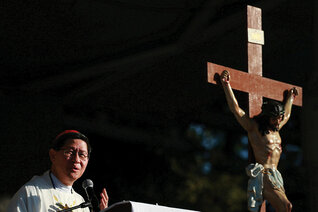
EDITOR’S NOTE: Cardinal Timothy Dolan, archbishop of New York, delivered the keynote address at the 57th annual Knights of Columbus College Councils Conference in New Haven, Connecticut, Sept. 30. The following text is abridged and slightly adapted from his address.
Your theme this weekend is Milites Christi — soldiers of Christ. Now at first blush that might strike us as a little odd. I mean, we have Jesus as the Prince of Peace; we also have the high priority of peace and justice in our beloved Catholic faith.
But Jesus himself often used military imagery, and soldiers have always had a particular attraction to follow Jesus in the Church. I’m thinking of the Roman centurion who went to Jesus for a cure [Mt 8:5-13; Lk 7:1-10] and the centurion who professed his faith in the divinity of Christ at the foot of the cross [Mt 27:54]. I’m thinking of saints such as Martin of Tours and Ignatius of Loyola. I’m thinking of military chaplains like Father Vincent Capodanno, Father Emil Kapaun and Father Francis Duffy.
There’s always been a kind of alliance between the charism of soldiers and the teachings of Jesus and the Church. And that was also the wisdom of Blessed Michael McGivney and why he used the word “Knights.” Of course, “Knights” has a military connotation — we are soldiers, we are knights, we are crusaders — and that charism appealed to the priestly heart of Father McGivney. This evening I want to propose I've lessons that we can learn from this military analogy.
TOGETHER IN SOLIDARITY
Number 1 is the lesson of togetherness — a lesson of solidarity. You know famous movies about soldiers like Band of Brothers. You know their saying, “No man is ever left behind.” So when we speak about soldiers of Christ, when we speak about Knights, we’re immediately centering on the necessity of solidarity, togetherness, fraternity.
Now this is diffcult today because we live in an era that stresses individualism. When I walk the streets of New York, nobody is looking at other people, they’re looking at their phones. Something good — technology — is being misused to destroy a sense of community and solidarity and fraternity.
It’s even true in the Church, which by its nature is a community, the Mystical Body of Christ. And what do we hear today all over the place? “I’m a believer, not a belonger. I’m into spirituality, not religion. God is my Father, but he’s not our Father.”
God has told us differently. God has always preferred to work with the people, whether it be the people of Israel or the New Israel, the Catholic Church. We’re in it together. And my brothers, the Knights of Columbus embodies that. Father McGivney knew that his men needed one another.
SHARED CONVICTIONS
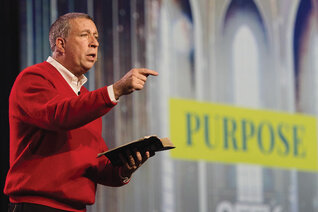
Here’s Number 2: Soldiers by nature have shared convictions. They may differ on a lot of things, but they have basic shared convictions that drive them and keep them going. An army always has direction and focus and purpose. It has a mission. Often, in our society, rudderless young men without a sense of direction join the military for a sense of purpose, focus and shared conviction.
I would reckon you guys on campus sometimes feel that the convictions you savor are not shared by others. You wonder: “Am I the only one here who believes in God? Am I the only one here who believes in truth? Am I the only one here who believes in the Bible and the Ten Commandments and the Beatitudes? Am I the only one who believes in the power of prayer and an upright, honorable life of virtue?”
Brothers, we are Knights, and we share basic convictions. We have a creed that we call the Apostles’ Creed. We believe in the commandments. We believe in salvation. We believe in heaven. We believe in Jesus. We believe in his one, holy, catholic and apostolic Church. We are often criticized or mocked for these shared convictions. So we need one another as an army does, in a militia of shared conviction.
THE POWER OF RITUAL
Number 3 is ritual. Our soldiers in the armed forces always have ritual. You know, a number of years ago, I went to the funeral of a soldier who was killed in Afghanistan, Michael Ollis. His brother soldiers were there bantering in the sacristy, recalling Michael, and I visited with them. But the minute they were called to order to begin their duties at that funeral, you could see them snap to attention, their eyes riveted on the ritual before them.
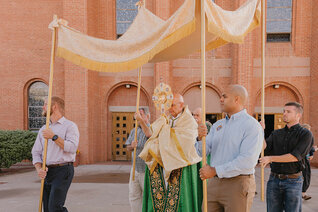
Soldiers know the power of ritual. Uniforms, ceremonies, pledges. We Knights have the same thing. We just went through one — the sacred ritual of the Mass — and we gathered afterward around the tomb of our Founder. In a way, that’s like soldiers gathering around the Tomb of the Unknown Soldier.
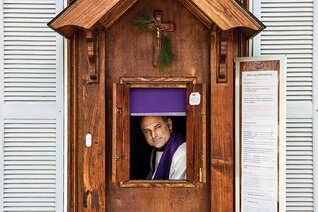
We have our sacred rituals, especially in the seven sacraments. You all have been formed, in baptism, confirmation, Holy Eucharist, the sacrament of penance. Some of you, I’m praying this evening, might be formed by holy orders as a priest. Most of you will be formed in the sacrament of matrimony. And all of us, one day, will have the sacred ritual of the anointing of the sick, when we’re sick or preparing to go home to the Lord. Those rituals drive us. And those rituals are very important to the Knights of Columbus. Rituals are important to military soldiers. Rituals are important to soldiers of Christ.
ALLEGIANCE TO A HIGHER CAUSE
A fourth lesson we can learn from Milites Christi, soldiers of Christ, is the utter necessity of allegiance and loyalty. Military men sense an identity that is beyond them. It transcends their individual self. It’s an allegiance to God and to country. It’s an allegiance to wives and families and homes and neighborhoods. It’s an allegiance to virtue. If they lose that allegiance, they begin to crumble. But once they have it, nobody can stop them.
Such allegiance characterizes effective soldiers, and it characterizes the Knights of Columbus. The Knights has always been driven by an allegiance and loyalty to our Catholic faith. Father McGivney formed his men to defend that faith — first of all by making sure that the faith was strong and vigorous within them, so that they could defend it beyond. That’s why the Knights of Columbus is right now at the forefront of defending religious liberty here at home.
This is the allegiance and loyalty that you and I have as Knights. Pope St. John Paul II said that nothing is worth living for unless something is worth dying for. And you and I believe something is worth dying for, and that makes living worthwhile.
“Allegiance characterizes effective soldiers, and it characterizes the Knights of Columbus. The Knights has always been driven by an allegiance and loyalty to our Catholic faith.”
READINESS TO FIGHT THE ENEMY
Number 5: Soldiers have an enemy. Sometimes the enemy might be an idea, like totalitarianism. Sometimes an enemy can be a particular country. Sometimes it’s more nebulous, like terrorism. Now Jesus told us to love our enemies. And we do. But we also know that one of the ways we sometimes love our enemies is to try to convert them by the truth.
Very often today the enemy is invisible. Yesterday, we celebrated the feast of St. Michael the Archangel, our defender in battle. That’s the realm of the invisible, my brothers. Satan is real. Remember what Pope St. Paul VI said: Satan’s greatest weapon is to make us think he doesn’t exist. The realm of the invisible — Satan, sin, evil — it’s out there.
What is invisible is most real. You ask what is most important in our lives, and it’s usually the things we cannot see: It’s love. It’s loyalty. It’s faith.
I’m so glad the Knights have fostered such a deep devotion to St. Joseph, who defended Jesus and Mary. He defended Mary from the embarrassment of an untimely pregnancy. He defended his holy family when Herod wanted to kill the newborn savior of the world, by fleeing as refugees into Egypt. And there’s a beautiful tradition that St. Joseph died before Jesus began his public ministry because he would have fought to prevent his son from being arrested and crucified. St. Joseph, the great defender. We — you and I — are called to be defenders.
What I’ve tried to say about this whole theme of Milites Christi, soldiers of Christ, is that it isn’t as bizarre as it sounds. Because as soldiers need togetherness, solidarity and fraternity, so do we as Knights of Columbus. As soldiers depend upon shared convictions, so do we as Knights. As soldiers savor ritual, so do we as Knights. As soldiers need to have an allegiance and loyalty, so do we as Knights. And as soldiers fight an enemy, so do we as Knights.
My brothers, that’s why I’m glad you’re here. You show that the values of Knights of Columbus as soldiers of Christ are now more timely and more urgent than ever.